Showing posts with label Pumalin. Show all posts

Saturday, 31 December 2011

Pumalin Park, Patagonia. Part 2: Volcano


We drive then clamber through a forest of skeletons to reach ground zero: flattened trees, decapitated trunks, all-consuming silver-grey ash and rock debris, with a seething mountainous blister backdrop – the Chaitén volcano. Its steam and pervasive eggy smell foretell a still angry volcano god, but scientists assert he is gradually calming down after his 2008 eruption that affected life in this part of the world so much. I’ve never seen anything like this before and struggle, in awe, to imagine what it must have been like here meeting the catastrophic force with the power to snap a four-foot tree trunk like a corn stem.


On the Carretera Austral approaching the forest of skeletons in the distance


Volcan Chaiten steaming angrily in the background

This vista and the drive to get here reinforces in my mind that Patagonian Chile is a geological contortion of immense proportions – a union of geo-forces that contrive a unique landscape – tectonics, volcanoes, wind, rain, sea, ice and snow, and biology. It’s raw, wild, isolated, and spectacular and the people who live here remain at the mercy of these elements, despite their attempts to civilize the land.


Return of the Nalca
Back by the blister in the forest of skeletons, we walk along the new trail being developed by Carlos’ team that will eventually take hikers to the edge of the rusty, steaming dome above us. Among the grey ash and white wooden bones, patches of green re-affirm nature’s own restorative powers without the need for our helping hand. A fern here, a fuchsia there and, most surprisingly to my Cornish garden eyes, gunneras everywhere. Gunneras, iconic garden plants of the country homes of the Cornish gentry, are sprouting everywhere. In Chile they’re called nalcas and there’s a range of different species. Here their leaf stalks used to be eaten in salads or made into marmalades. 


The Chaitén eruption forced the closure of the popular southern part of Pumalin Park for three years as roads were blocked for miles with fallen trees and assorted mineral debris. They have only very recently been re-opened and Carlos is hoping that this summer will see visitor numbers increase. After motoring through forests shadowed by ice-capped mountains and passing reflective lakes, we arrived at the beautifully-appointed El Volcáns camp-site on the flat valley floor of the Rio Rayas, which has just been restored to its former glory after the eruption. It was originally built on a site devastated by poor forestry practices; now, the new buildings and camp-site shelters continue the Pumalin design tradition that I am coming to expect. The camp-site will re-open in the next few days


The regional town of Chaitén was almost erased from the map as the eruption smothered buildings and roads under several feet of volcanic ash, transforming the local geography. The authorities did a sterling job evacuating the population – apparently no-one died – but in the aftermath wrote the town off. Today, over three years since the earth burped, the local geography remains transformed: the beautiful bay is now a new delta of volcanic debris, the town’s river sports the skeleton of a fragmented timber building and many others remain half buried with grey ash. Rows of empty homes and businesses tell that many residents did not return; those that did seem to be slowly turning the volcanic tide. Tourist accommodation is increasing, reflecting the main economic driver based on the surrounding natural splendour. And all the time, the volcano, one of three in the immediate vicinity, steams ominously to the north at the head of its eponymous valley.


Another skeleton forest - view from the back
El Amarillo is a small, roadside village at the south entrance to Pumalin Park, where we stop for lunch. Then Carlos, Irwin – the head of this sector of the park – and I head up the valley to hike a new trail being constructed to an old camp site. Irwin and Carlos are evidently used to this kind of uphill hiking thing as the distance between them and me gradually lengthens, making me feel like I’m walking backwards – I use the excuse that I keep stopping for photos! The trail up is beautiful and courses by the side of the fast-flowing, turquoise Rio Amarillo. As we increase in altitude through the forest, volcanic ash grades from a light dusting to a two-foot coating and the trees around us turn from vibrant spring leaves to silver-grey standing dead – the day’s second skeleton forest. We are a few miles southwest of the Chaitén volcano, but it’s hidden behind an intervening mountain. However, we do have spectacular views of its larger volcanic neighbour, Volcán Michimahuida, with its permanent ice cap and tumbling glaciers. Michimahuida is less explosive that its recently eruptive companion as its more fluid basaltic lava flows rather than explodes; it is this black rock that the river is slowly eroding.


We reach the top of the hill, in the middle of a post-apocalyptic volcanic wasteland, to suddenly happen upon a surprisingly fresh, green field. My first (speechless) reaction is ‘golf course’ – incongruous as it appears, until Irwin explains that this is a very recently restored camp site that was inundated under metre of ash when Chaitén let rip. His team has just finished removing and leveling the ash and planting new grass. They intend it to be open for the first time in three years within a fortnight.


View from the restored camp site: Volcan Michimahuida and one of its glaciers


Gulley in place of the original path
The path we have just walked up is also the way down; however, Irwin is keen to show us the old path that is no longer usable after the damage inflicted by Chaitén. We pick our way through an arboreal obstacle course of fallen trees and use thin trunks as improvised bridges to cross four metre deep, blackened gullies where the path once ran. Quite exciting but, darn it, I just can’t keep up with those boys!


Hidden path

A couple of hours later after a quick drive back, I am in Pumalin’s excellent Caleta Gonzalo café. Carlo and his wife, as usual, serve me scrumptious, home-cooked, local food. It’s getting dark outside and will be a much cooler night than of late. The local ferry has just broken down causing a queue of waiting vehicles up the slipway. Their occupants – people of all ages – are huddling around the welcoming, crackling wood fire in the corner of the café so, for once, I am not eating alone.

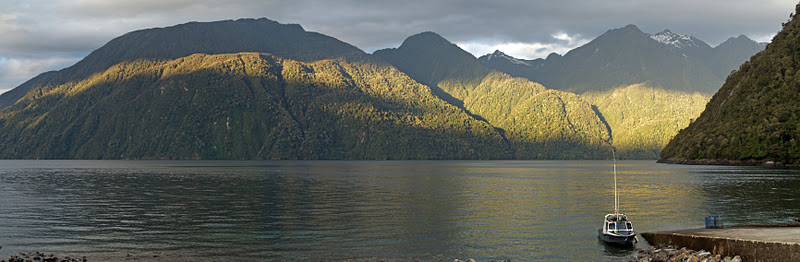
Last night: Renihue Fjord from Caleta Gonzalo

Tonight is my last night in Pumalin Park. Tomorrow I venture south on a long road trip along the Carretera Austral with two people I don’t know, for several days of who knows what experiences in the wild wilderness of Patagonia. Bring it on!

Wednesday, 28 December 2011

Forest Colossi


About 15 minutes’ ripio drive from Caleta Gonzalo, aside the Carretera Austral, is a magical forest of bejeweled, green giants giving a rare glimpse of how much greater the still spectacular Valdivian rainforest once was.


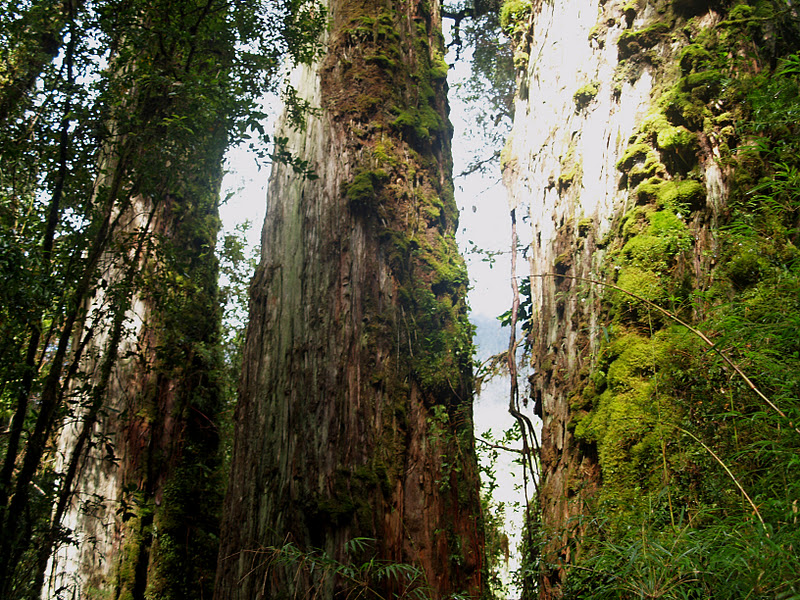
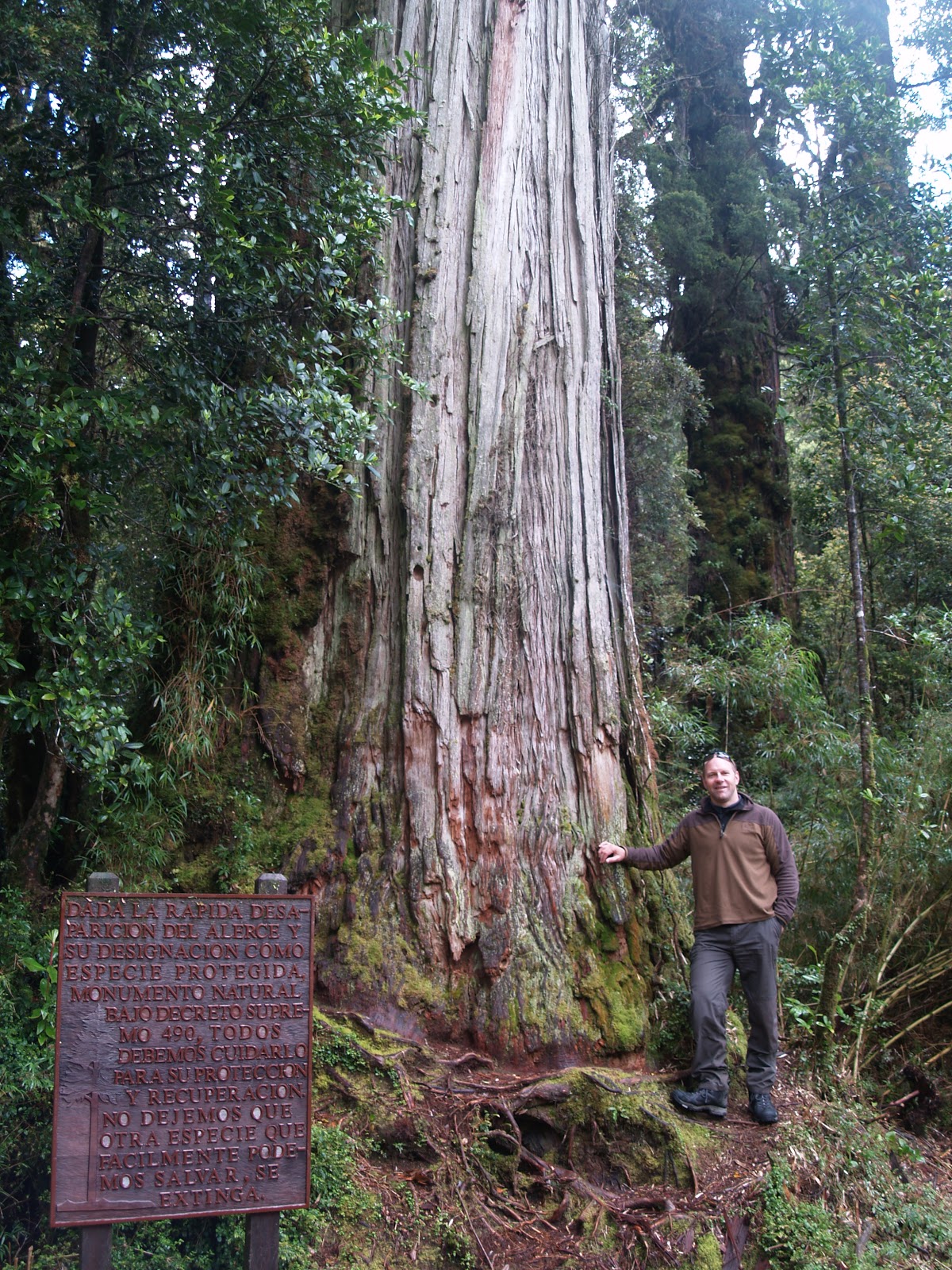
The Alerce pine is among the world’s oldest and most massive living things. These remarkable trees (see last blog) were once common over thousands of square miles of Patagonia; today, Pumalin Park retains about 25% of the world’s population. The Alerce Trail, along which Carlos and I are hiking, traverses the translucent, tumbling river that drains the surrounding mountains, swollen by yesterday’s heavenly outburst (today’s broken cloud and patchy blue sky are a welcome relief). I feel like a mouse crawling through a corn field as the trail weaves us around stout, towering columns in the domain of giants. The Alerces, festooned with moss, ferns and other hanging greenery, sparkle like a million fairy lights as yesterday’s captured raindrops glint in shafts of sun. Their fibrous, red-brown bark coating trunks of massive girth is similar to that of California’s sequoias, as is their slow rate of growth. Alerce timber has been sought after for decades causing the rapid decline of these trees. Their regeneration on surrounding hillsides has been stymied by frequent forest fires as witnessed by their denuded, white skeletons, frozen, grasping for the sky above the surrounding southern beeches. Thankfully the protection and restoration afforded by Pumalin’s dedicated people means that, in patches, the Alerce forest is gradually returning.


Uplifted on leaving the impressive Alerces we continue south along the Carretera Austral, Carlos pointing out features of interest on the way. Although the park is private land the Carretera running through it is a public road and, as the authorities maintain the road, they lack care over restoring the natural aesthetic and leave linear, eroding scars of bare soil and uprooted trees that line the road for miles through the wilderness. A contrast to the elegant forest experience that I have just had; come on Chile, you can do better than that!

Saturday, 24 December 2011

Pumalin Park, Patagonia. Part 1: Rain

Happy Christmas to all you fine people, wherever you are, and a big, festive thank you for taking the time to read my blog!

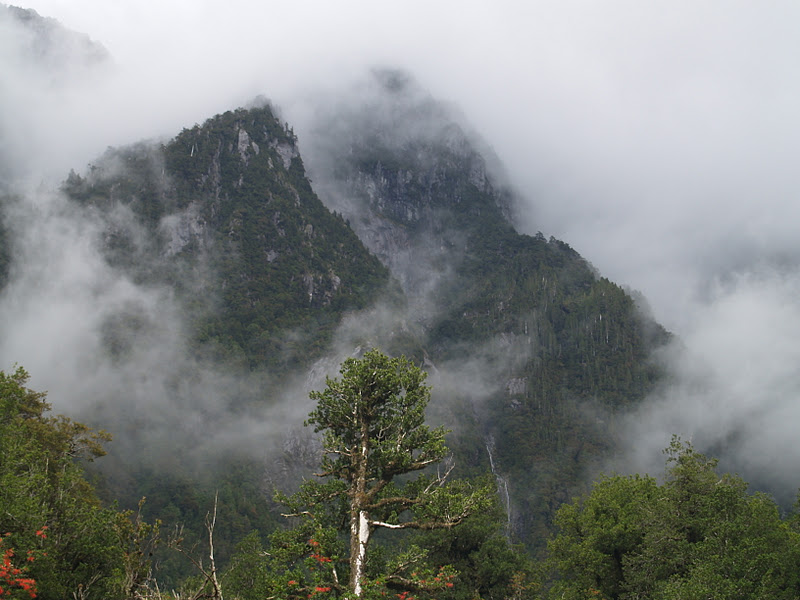
Now I know how a fairy feels atop a Christmas tree, sort of! The key differences, other than gender, being that I’m dressed from head to toe in sodden, black waterproofs and the tree on which I’m perched has neither branches nor leaves (although it did once). I’m on the lower slope of a high mountain, surrounded by a young forest of bright-leaved, Southern Beech trees emerging through the fallen, weather-bleached, wooden skeletons of their parents. The weather has changed completely from yesterday’s endless blue skies to an all-enveloping, sombre spectrum of muted greys, heavy clouds roofing the misty fjord down to the slatey sea at the mouth of the U-shaped Vodudahue Valley. It’s raining – lordy is it raining! This coastal part of Chilean Patagonia receives seven metres of rain per year and it all appears to be arriving at once – today. My waterproofs lived up to their name for less than ten minutes – and that was three hours ago! The torrential rain greases the inclined log on which I’m teetering, but the view along the valley in this small part of Pumalin Park is stunning nevertheless.

Vodudahue river in the pouring rain
Carlos and the farm from the top of my perch
I am accompanied by Carlos, the Head Guard at Pumalin Park, who is generously giving me a two-day tour of landscape restoration work around the park. First stop is Vodudahue Farm, one of several around the park. Geography makes even short distances here an adventure; the few kilometres from my Caleta Gonzalo cabaña involved two boat rides and a short stretch of ripio, followed by a two-kilometre drive on a tractor trailer! During an early engagement in our respective languages, with rain dripping off the ends of our noses, we agree a bilingual approach; Carlos talks in English to practice my native tongue, I speak in Spanish to enhance his. During the damp walk through the farm and the tricky scramble up to our current vantage point, Carlos and I discussed the purpose and the work of the tree nursery which raises native trees to restore the surrounding rainforest, and the fruit farm where a range of berries are grown, including the delicious, native murta. From our hill-side viewpoint Carlos points out the neat rows of the tree nursery, the restored and well-maintained farm tracks and the red-roofed, timber farm buildings reflecting the predominant reds and browns of the rainforest in the architectural mind’s eye of their designer.


Soaked!

Rainforest colour in the gloom

Pumalin extends over 1,200 square miles of Chilean fiords and mountains, blanketed in seemingly endless Valdivian temperate rainforest and home to spectacular animals, large and small, such as the puma and the humming bird. The names of the park and its top predator imply an etymological link, reinforced by their combination in the park logo, but Carlos explained that Pumalin, in the indigenous language, is a dry piece of land between wet areas, whereas puma is, er, a big cat! The park is nationally protected, but privately-owned by the Conservation Land Trust (CLT) – a charity set-up by Doug Tompkins to acquire and preserve important wilderness areas. He also lives locally, in fact, a few kilometres around the corner by boat! The fascinating story of the man, his wife (Kris Tompkins) and their work is described a million times on the internet, so I won’t go into too much detail here. Suffice it to say that I am now immersed in it, and will be for the next two weeks, and the results are exemplary and world class.

Before the park the land was not protected and, as over vast areas of Patagonia, the flatter valley floors and less steep valley sides were converted to cattle and sheep farms by pioneers during the 20th century, which involved clear-cutting and setting fires to clear the densely forested land. Millions and millions of hectares of land were cleared in this way – sometimes the fires burning unchecked for months. The fragile forest in areas not blessed with land good enough for agriculture was logged extensively for valuable timber trees such as the Alerce pine – the Patagonian equivalent of California’s spectacular redwoods in both size and age. They were extracted, damaging the surrounding forest and depleting much of the Valdivian temperate rainforest of these impressive arboreal giants.

Carlos with Alerce saplings
When Vodudahue was originally acquired it was a depressing economic and environmental disaster area, over-grazed by sheep and cows, crumbling riverbanks, broken fences, pot-holed and eroding roads, dilapidated buildings and degraded forests with no chance of regeneration given the intense grazing regime and frequent fires. Today, the farm is organic and produces berries, native trees and the most delicious honey I have ever tasted. It also farms horses and the aim is for these to become working horses. Farm products are sold throughout the CLT-owned properties in Chile and in various shops in the towns scattered widely through southern Chile. A new programme is being developed for visitors to Pumalin Park to sponsor an Alerce pine sapling to raise funds to restore these already impressive forests to their former magnificence.

On the return from Vodudahue, at the end of the day, it is still raining and still grey. Carlos invites me into his cozy house at the restored Pillán Farm, in the next valley along (which involves rides on a tractor, boat and truck), where I am introduced to his wife and we share coffee and chocolate (two dietary staples of mine). Pillán also serves as one of the main office areas for the Pumalin Park. The isolation and rugged terrain impedes communications – both physical and electronic – so each sector of the park has its own office and workshop infrastructure. The Pillán workshop originally provided the finely crafted furniture of my cabaña and all made from local wood.


Boat taxi

Tractor taxi

Already, from my experiences of Pumalin’s buildings in Puerto Varas, Caleta Gonzalo, Vodudahue and Pillán, I can see that great effort is expended on creating a homely architectural and interior design style that speaks a common language through and around the scattered settlements and restored buildings of the park. It’s a language of local, natural materials, attention to detail and quality, and a rusticity adapted from the American wilds, with a hint of a Shaker accent. Geographically, I feel lost in the middle of nowhere; geography and design meet awkwardly here at first experience, particularly in my already overwhelmed head, but with increasing exposure they combine creating a unique sense of place – simultaneously welcoming and wild!

Carlos' house

A restored building at Vodudahue farm
My cabana

Back in my cabaña after a long, damp day, I hang my dripping clothes around the small, electric radiator powered by a micro-hydropower turbine in a nearby mountain stream. The turbine’s oscillations cause a cyclical flickering in my low wattage, bed side light bulb. The rustic interior walls of un-planed timber, some with residual bark, create a relaxing texture with the mellow light as I settle for the night. It just feels right.

Tomorrow, Carlos and I will be heading deeper into the park. I hope by then my clothes will be dry. Read about it in the next blog.